
CARBON CAPTURE
CO₂ Storage
Riverside Energy is advancing carbon storage solutions in Michigan by leveraging proven geology, extensive operational experience, and a commitment to safe, responsible development.
Safe, Proven Carbon Storage Solutions
Riverside Energy is helping advance carbon storage solutions in Michigan by leveraging decades of subsurface expertise and the unique geology of the Michigan Basin.
Through careful site selection, advanced engineering, and continuous monitoring, captured carbon dioxide (CO₂) can be safely stored deep underground, preventing it from entering the atmosphere.
What Is Carbon Capture and Storage (CCS)?
Carbon Capture and Storage (CCS) is a process that captures carbon dioxide from industrial facilities and other emission sources before it reaches the atmosphere. The captured CO₂ is then transported to a secure storage site and injected deep underground into carefully selected geological formations.
By permanently storing CO₂ below the surface, CCS helps reduce emissions while supporting economic growth, energy reliability, and industrial production.
Carbon Capture FAQ’s
-
CCS means Carbon Capture and Storage. It’s a process where carbon dioxide (CO2) is captured from industrial sources and stored deep underground so it doesn’t enter the atmosphere.
-
Storing CO₂ underground prevents it from entering the atmosphere, where excess greenhouse gases contribute to climate change. CCS is a critical tool for reducing emissions while supporting energy reliability and industrial operations.
-
CO₂ is stored in deep underground rock formations, such as depleted oil and gas reservoirs. These formations have natural spaces (called “pore space”) that safely hold CO₂ . A layer of impermeable rock above, called a “cap rock,” keeps it sealed in place.
Niagaran Pinnacle Reef formations in Michigan are particularly well-suited for CO₂ storage.
These reefs feature thick porous rock that holds CO₂ securely, capped by dense layers that naturally keep it locked in. Decades of successful natural gas storage in these formations demonstrate their integrity and reliability.
-
CO₂ is injected deep underground through specially designed wells. Once injected, it enters porous rock layers where it becomes a supercritical fluid, behaving like both a gas and a liquid. This allows it to fill tiny spaces in the rock, much like water in a sponge. Above these layers, dense rock formations act as natural seals, keeping the CO₂ securely in place.
Niagaran reefs provide ideal conditions for this process, with thick porous zones for injection and strong sealing layers above. Continuous monitoring helps ensure the CO₂ remains safely stored.
-
Yes. The Michigan Department of Environment, Great Lakes, and Energy (EGLE) oversees
these projects. For large-scale storage, the U.S. Environmental Protection Agency (EPA) is currently the lead regulator. Michigan doesn’t have full authority (known as “primacy”) yet but is working toward it through pending CCUS legislation.
-
CO₂ isn’t toxic, but in high concentrations it can displace oxygen and cause suffocation, especially in enclosed spaces or low-lying areas where it could collect. That’s why safety systems and strict regulations are in place to detect and stop leaks quickly. In open areas, CO₂ usually disperses into the air, and continuous monitoring ensures risks remain very low.
-
A typical CO₂ storage site includes:
Pipelines to transport CO₂ to the site
Compressors and dehydrators to prepare the CO₂ for injection
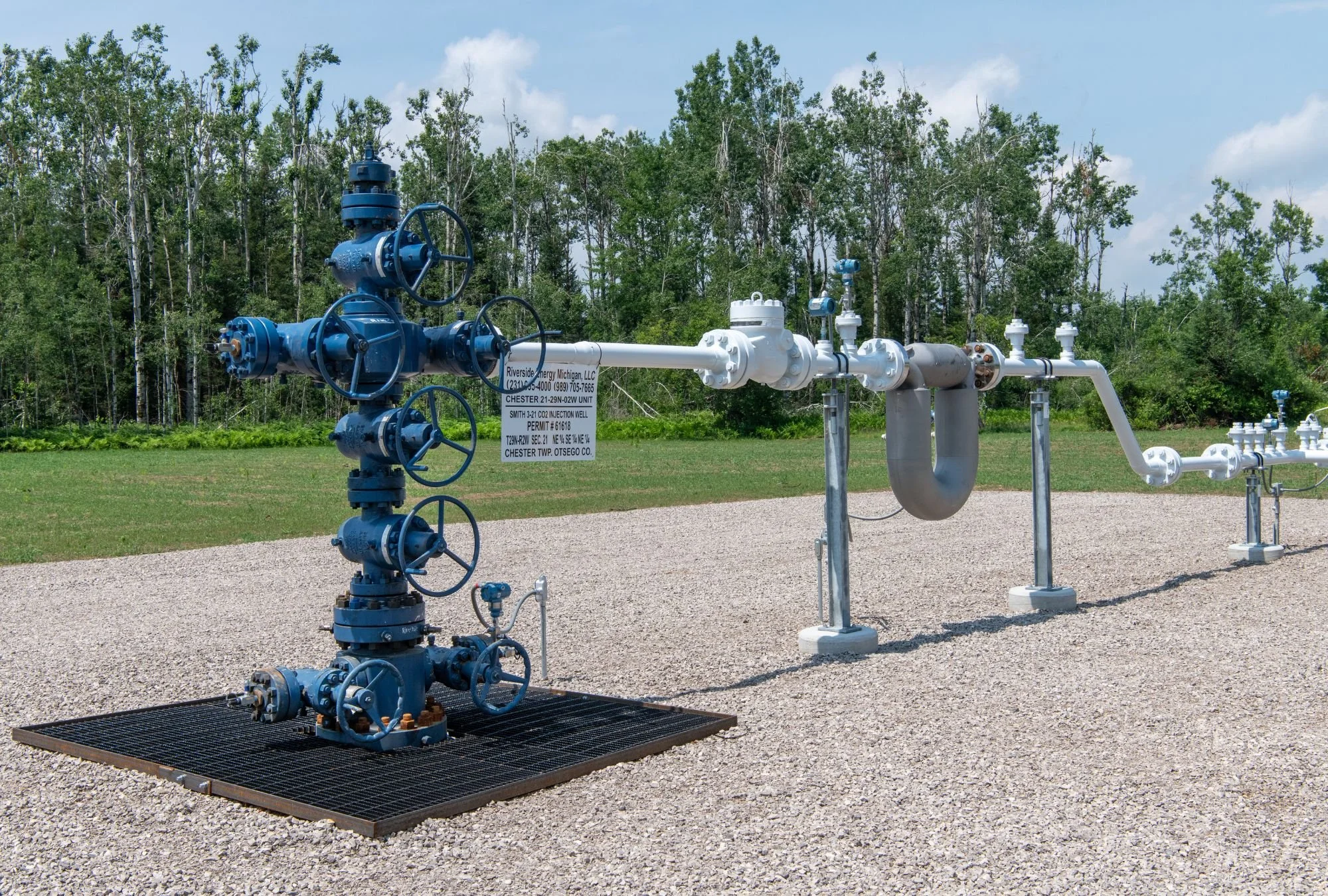
Injection wells that deliver the CO₂ deep underground
Monitoring systems that track safety, pressure, and performance
The entire surface facility typically occupies about two acres.
-
CO₂ is usually transported through pipelines in a dense, pressurized form similar to a liquid. The exact state depends on temperature and pressure conditions. For example, at some of our sites, CO₂ may be in a vapor state during cooler times of the day.
-
Sometimes. If a pipeline passes safety and pressure tests, it may be reused. Otherwise, new pipelines are built, often along existing routes to reduce land impact.
-
The risk is very low. Projects must meet strict federal and state safety standards. The underground rock layers and well construction are designed to keep CO₂ securely in place. We also monitor the site continuously to catch any issues early.
Michigan’s reef formations have natural sealing layers and a long history of safe gas injection, which further reduces risk.
-
No. CO₂ is not flammable or explosive. If a pipeline were to leak, it could make a loud noise and release gas quickly, but it wouldn’t catch fire. Safety systems like automatic shut-off valves and aerial inspections help prevent and detect leaks.
-
CO₂ is a natural part of the air we breathe, but too much of it in the atmosphere contributes to climate change. Storing it underground helps reduce emissions.